
Dosing 101: How to Read Aquarium Labels Without Losing Your Mind
We’ve all been there. You’re standing in front of your tank, holding a bottle of fertilizer or water conditioner, squinting at a label that seems like it was written by someone who enjoys making life difficult.
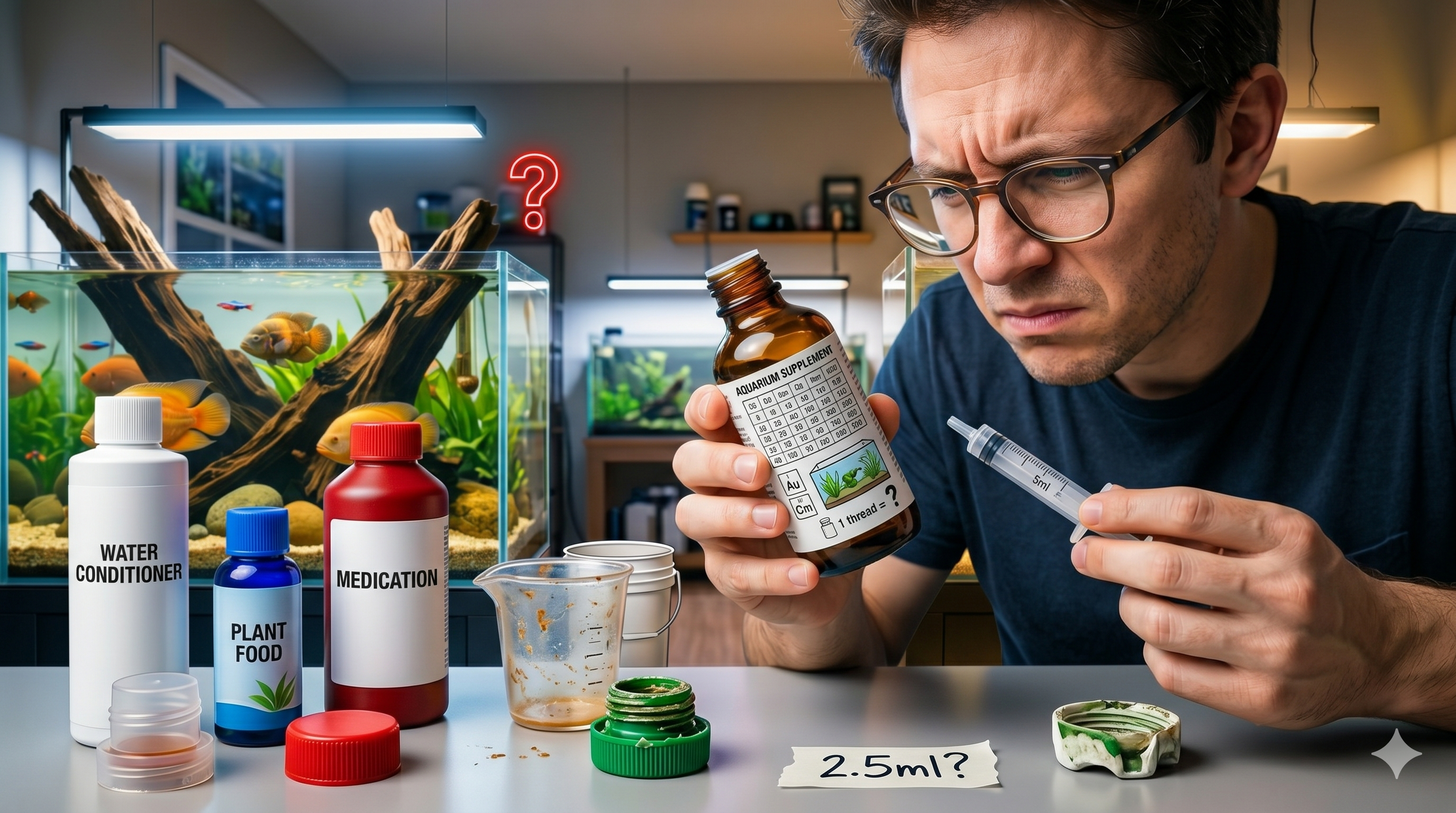
The instructions say something helpful like, "Add one thread of the cap for every 10 gallons." Wait—a thread? Like, a literal screw-thread on the inside of the plastic lid? Who measures things in threads? And what if I have a 29-gallon tank? Do I do two threads and... a partial swirl?
If you feel like you need a PhD in chemistry just to keep your plants green, don’t worry. It’s not you—it’s the labels. Dosing your aquarium doesn't have to be a guessing game, but you do have to learn how to translate "Marketing Speak" into actual measurements.
Dosing doesn't have to be a mystery.
Calculate dosing nowThe "Capful" Trap
Manufacturers love the "capful" measurement because it sounds convenient. You don't need extra tools, right? Just pour and go.
But here’s the problem: cap sizes change depending on the size of the bottle you buy. A 250ml bottle might have a tiny cap, while the 2-liter jug has a cap the size of a shot glass. If you’re used to the small bottle and you switch to the big one, you might accidentally quadruple-dose your tank just by habit.
The Golden Rule: Never trust a cap. Always look for the actual milliliters (mL) listed in the fine print.
Decoding the Math
Most labels follow a standard formula: [X amount of product] treats [Y amount of water].
The trick is that "Y" is almost always a nice, round number like 10 or 50 gallons. But very few of us have exactly 10 or 50 gallons of actual water (remember our talk about displacement?).
If a bottle says 5mL treats 50 gallons, that means 1mL treats 10 gallons. If you have a 20-gallon tank, you need 2mL. It sounds simple when the numbers are round, but when a label says "7.5mL for every 38 liters," your brain is allowed to short-circuit a little.
Pro-Tip: Get a Syringe (Seriously)
If you want to move from "beginner" to "pro," stop pouring from the bottle. Go to your local pharmacy and ask for a 5mL or 10mL oral syringe (the kind they give out for baby medicine). They’re usually a buck, or sometimes they'll even give you one for free if you tell them it's for your fish.
Using a syringe changes everything:
- No More Mess: No more sticky liquid dripping down the side of the bottle and ruining your wooden stand.
- Deadly Accuracy: You can measure 1.2mL perfectly. You can’t do that with a plastic cap and a prayer.
- Safety: Overdosing certain things, like Excel or copper-based meds, is dangerous. A syringe removes the "oops" factor.
What Does "Maintenance Dose" Even Mean?
You’ll often see two sets of instructions: "Initial Dose" and "Maintenance Dose."
- Initial Dose: Usually a larger amount to "charge" the water after a big water change or when starting a new treatment.
- Maintenance Dose: A smaller, regular amount to keep levels stable.
If you’re confused, always lean toward the Maintenance Dose. In the aquarium world, slow and steady almost always wins. Drastic changes in water chemistry—even "good" changes—can shock your fish.
Ready to find your perfect dose?
Calculate dosing nowDon't Dose the Whole Tank (Unless You Have To)
One final tip: If you’re using a water conditioner like Prime or Stress Coat during a water change, you only need to dose for the new water you’re adding, provided you're mixing it in a bucket first. If you're dosing directly into the tank while the hose is running, then yes, you dose for the total volume of the aquarium. Reading the label carefully will tell you which one the manufacturer recommends.
Make it Easy on Yourself
You shouldn't have to do long division every Tuesday just to feed your plants. Once you figure out the math for your specific tank, write it down.
Grab a piece of masking tape, write "2.5mL per week" on it, and stick it right onto the bottle. Future-you will be very grateful when you're trying to do maintenance on a Sunday morning before your coffee has kicked in.

Written by Richard James
Aquarist, author, and creator of ShrimpKeeper.co.uk. Helping hobbyists achieve professional results through precision dosing.
View My YouTube Channel & Books →