
Setting up a Tank? Here’s How to Get Your Measurements Right from Day One
Setting up a brand-new aquarium is a rush. You’ve got the fresh, empty glass, a pristine bag of substrate (that always smells like beach air for some reason), maybe some cool dragon stone or a gnarly piece of driftwood. You’re already picturing the school of rummy nose tetras and the vibrant green of the Anubias you're going to plant.
It’s easy to get ahead of yourself. You just want to fill it up and see it exist.
But this is the absolute best—and honestly, the only—time to answer the single most important question you will ever ask about your tank: How much water does it actually hold?
Do this right, and everything that comes next (cycling, dosing fertilizer, calculating medication, managing algae) becomes a straightforward process of checking a label. Guess it, and you’ve just built your whole hobby on a foundation of "rough estimates." And in a high-stakes, closed environment like an aquarium, rough estimates can be deadly.
Dosing correctly starts on day one.
Calculate dosing nowThe Problem with "Nominal" Volume (And Why We Talk About It a Lot)
When you buy a "20-gallon long," that 20 gallons is the nominal volume. It’s calculated based on the external dimensions of the glass box. It does not account for:
- Glass Thickness: (Internal space is smaller)
- The Fill Line: (You don't fill to the very top)
- Displacement: (This is the critical variable)
Everything you put in the tank—every pound of sand, every decorative rock, every piece of wood—steals space from the water. If you’re building a heavily "scaped" Iwagumi tank with multiple large stones, you could easily reduce your 20-gallon tank to 15 gallons of actual liquid space.
What’s the Danger in Dosing "20"?
If you start dosing your cycling bacteria, water conditioner, or fertilizers based on that "20 gallons" on the box, and you actually only have 15 gallons of water, you are instantly overdosing by 25%. Every single time you add a product, you’re hitting your tank with 25% too much chemical, fertilizer, or medicine. For sensitive species like shrimp or specific loaches, that extra 25% is the difference between a thriving tank and a disaster.
The "Pail Method" for Day One Precision
Since you’re already standing there with a brand-new, empty tank, we are going to use the gold standard method. This is the only way to be 100% accurate.
- Place Your Tank: First, make sure your tank is exactly where you want it. This method requires filling it, so it can't be moved afterward.
- Add Your (Pre-Rinsed) Substrate: Put in all your sand, soil, and gravel. Create your slopes and contours.
- Arrange Your Hardscape: Place your rocks, driftwood, and any large ornaments. Crucially, do this while they are dry (or slightly damp).
- Add Your Equipment: Install your filter intake, heater, and any other submersed items (like a CO2 diffuser).
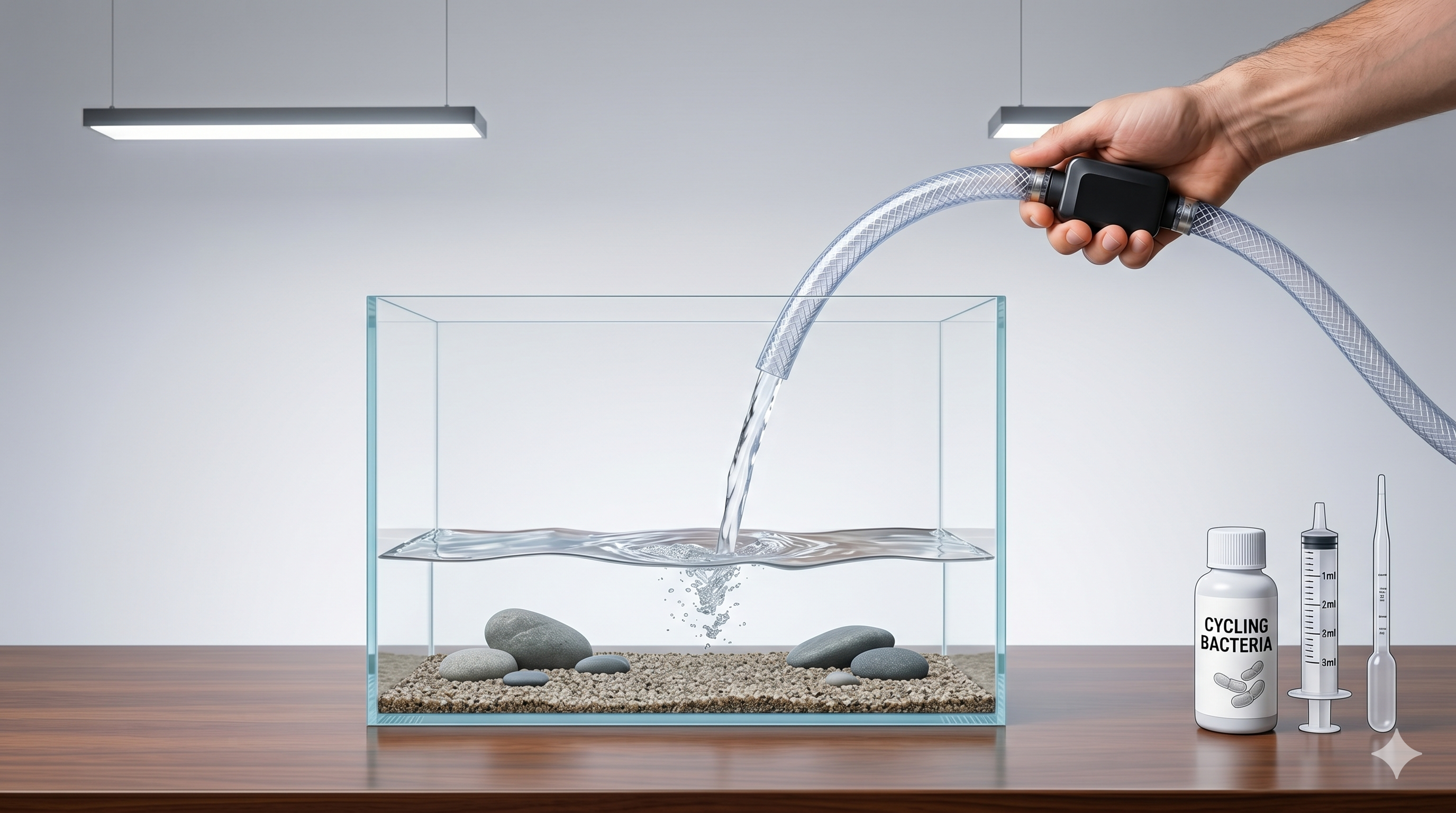
- Get a Marked bucket: This is your precision instrument. Grab a clear 2-gallon or 5-gallon bucket that has clear volume measurements (or mark it yourself).
- Slowly Fill and Tally: Start filling the tank, bucket by bucket. Use a small cup or colander over your substrate to prevent it from blowing around. Keep a clear tally on a piece of paper (or use masking tape on the side of the tank). Count exactly how many buckets of water it takes to reach your final fill line.
If your brand-new 20-gallon tank only accepts 16.5 gallons before the water reaches the top, that is your actual volume. Take a sharpie, write "ACTUAL VOLUME: 16.5G" on a piece of tape, and stick it inside your cabinet or on the back of the tank.
Ready to find your actual volume?
Dosing calculatorDon’t Get Caught Without Your Syringe
The other critical day one task? Buy an oral dosing syringe. Now that you know you have exactly 16.5 gallons, don't revert to guessing with a bottle cap. Spend $2 at a pharmacy for a 5mL or 10mL plastic syringe.
It changes everything. Now you can dose 1.6mL perfectly for your actual volume, instead of two "threads" for an imaginary volume.
Measurement is Consistency. Consistency is Success.
The key to a successful aquarium isn't luck; it's consistency. Your first measurement is the initial anchor for that consistency. Knowing your true volume from day one makes your water changes more accurate, your fertilizer routine more effective, and your entire fishkeeping journey much safer.
Before you add a single drop of anything to your new tank, make sure you know exactly what you’re adding it to. Don’t guess. Measure it once, measure it right, and enjoy the peace of mind that comes with knowing the precise math of your tank.

Written by Richard James
Aquarist, author, and creator of ShrimpKeeper.co.uk. Helping hobbyists achieve professional results through precision dosing.
View My YouTube Channel & Books →